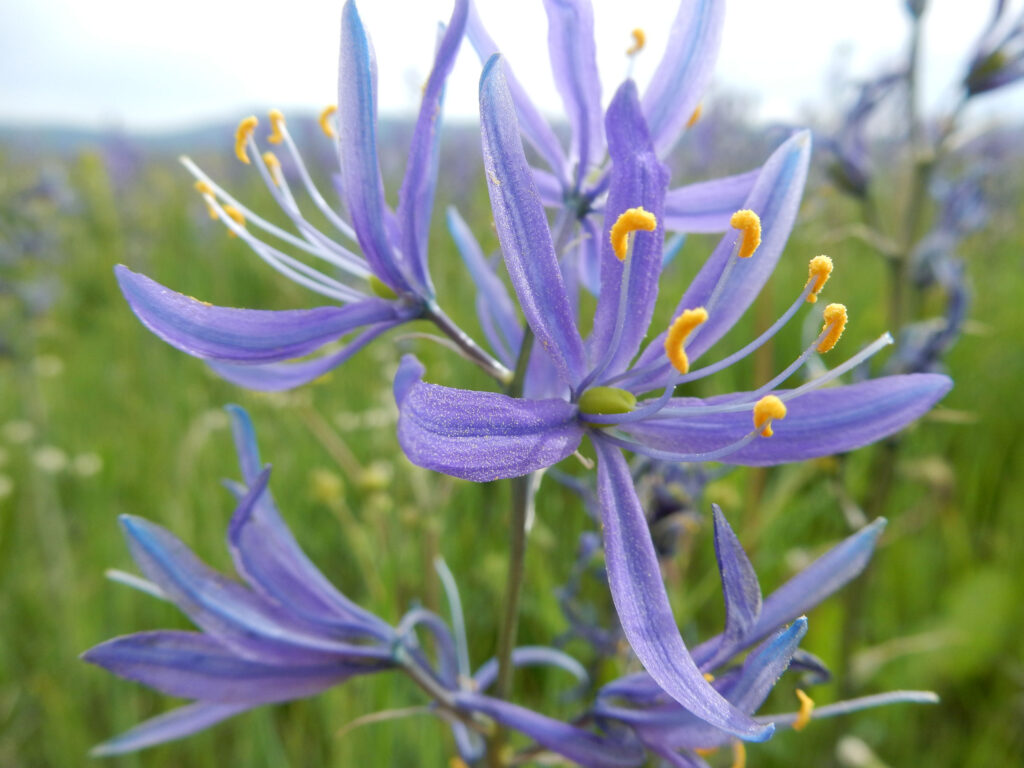
Camassia quamash
Spokane Salish: Etqhwe
Camas grows in moist mountain meadows, wet prairies, and valley bottoms. In springtime, camas prairies bloom into a sea of blue-purple flowers. Camas often grows near a toxic plant commonly known as death camas (Toxicoscodion veneosum), so it’s important to recognize the difference between the flowering plants.
Salish, Nez Perce, and other tribes would travel great distances to camas prairies every spring, where they would make camp to harvest, cook, and preserve camas bulbs. Each family “owned” a camping and harvesting spot, which would be passed from one generation to another.
Camas was such an important food source that indigenous peoples actively maintained enchased camas prairies through burning, weeding, hoeing, and harvesting selectively. They even transplanted camas beyond its native range to other suitable locations.
Before the plant is harvested, an offering and prayer must be made to request permission to harvest. If permission is granted, the Creator must be thanked for the food, as it is considered a gift. Traditionally, women harvested the camas bulbs in June, right after flowering, following the bitterroot and lomatium season.
The bulbs were typically baked in pits in dug-out pits in the ground over the course of three days. Initially, ponderosa pine needles were added to sweeten the camas; now, alfalfa is added for the same purpose. The prolonged cooking time transforms the indigestible raw bulbs into a sweet, soft, delicious food.
Once baked, the camas could be dried, ground and mixed with flour, water, and butter to make a gravy or boiled with dried bitterroots. Whole camas bulbs could also be dried and stored, and later boiled for eating. Camassia quamash is commonly called “black camas,” as the bulbs turn black when pit cooked.