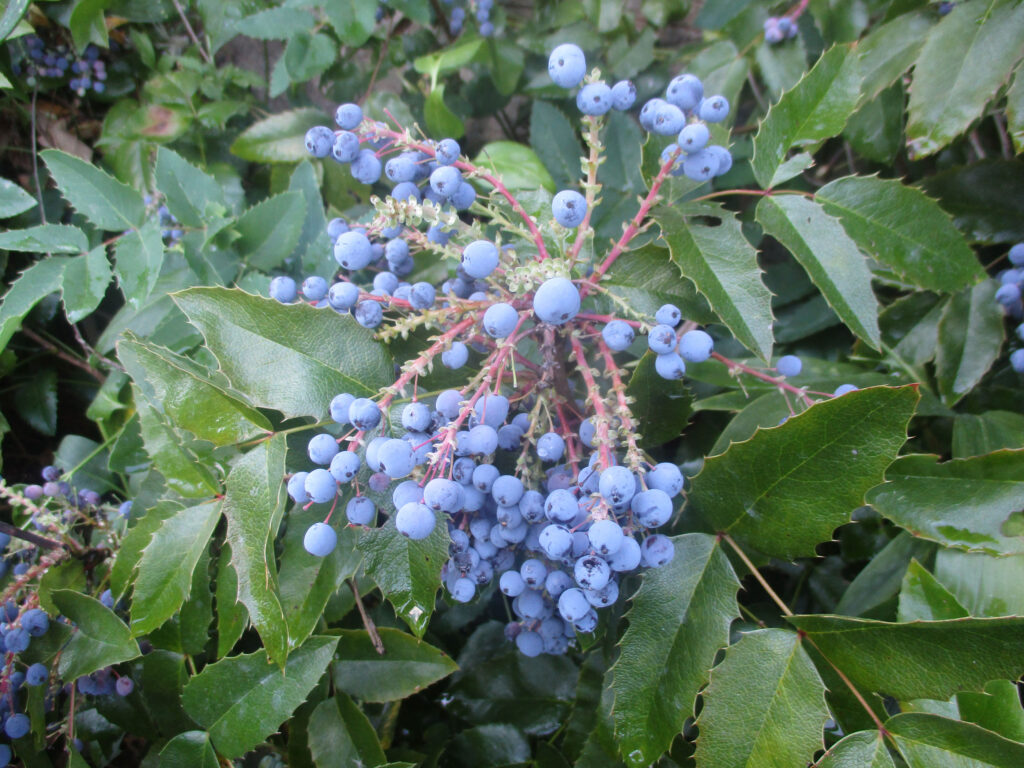
Berberis aquifolium (aka Mahonia aquifolium)
Spokane Salish: Sqweyu', sts'erfs, sts'ersilhmix (bush), sts'ars or sts'eris (berries)
Oregon grape is a shrubby perennial with dark green, waxy leaves. This wide-ranging plant grows in dry or moist areas, in open or dense forests, on brushy slopes, and in plains and valleys. The roots have a bright yellow color, indicative of the berberine compound, which has anti-bacterial and anti-inflammatory properties. And the fresh berries – although tart – can be dried, juiced, or made into cakes with other berries to offset the sour flavor.
Interior Salish tribes prize the berries and roots for their medicinal qualities. The First Peoples of Oregon, Washington, and British Columbia made a bitter tea from the root that was used as a general tonic to treat weariness, loss of appetite, digestive problems. It could also be gargled to treat sore throat & bronchial infections. The fruit was used as a mild laxative.
The boiled roots also yield a tea used to improve skin conditions like acne and eczema, ease digestive complaints, heal sore eyes as an eyewash, and act as a tonic for the kidneys. It was also used as a “blood purifier” and could be particularly helpful to take at the beginning and end of winter. Berberine, it should be noted, is unsafe for pregnant or nursing mothers, as it can cause brain damage in infants.
The roots, best harvested in the late fall, yield a bright yellow dye that the women used for basket materials and fibers. Mixed with wolf lichen (Letharia vulpina) the dye produced a deeper yellow pigment.
Some tribes also used Oregon grape for protection against bad spirits, placing the prickly branches in a person’s grave and in the home where they lived to prevent their ghost from returning.